
Imagine: you are watching an exciting movie in HD, while someone else is video calling and the kids are gaming. Everything works, without interruptions. That is the fiber can make. But what exactly is the difference between fiber, cable, and DSL? Bas Meeuwissen, Passive Infrastructure Architect at Open Dutch Fiber, explains the key differences. This way, you can see which connection suits your situation best.
What is the difference between fiber and cable internet?
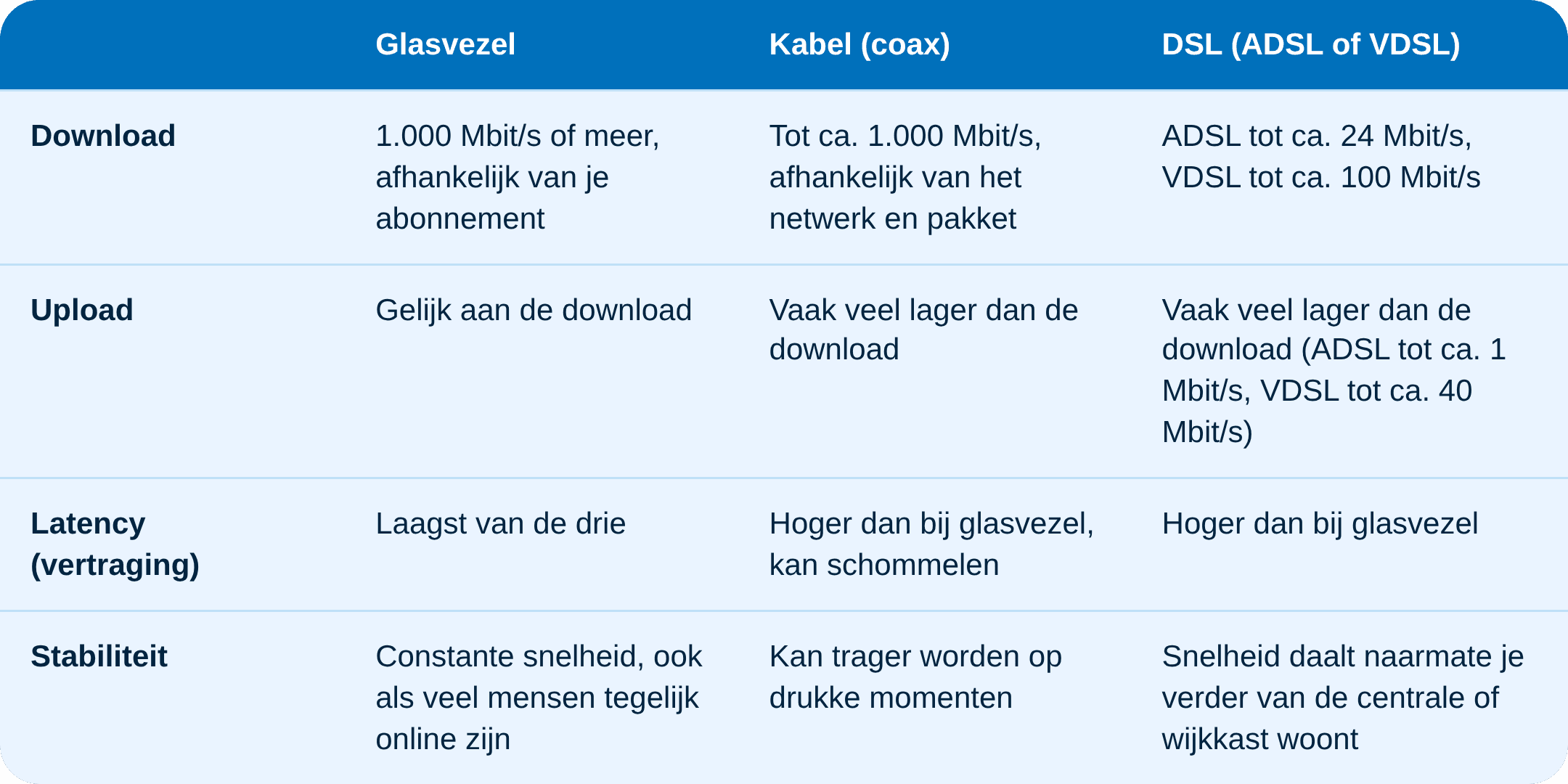
Fiber sends data as light through a glass cable. Cable internet (coax) and DSL (ADSL or VDSL) use copper. As a result, fiber is faster and more stable, and your upload speed is equal to your download speed. With cable, it can slow down during peak times. With DSL, the speed decreases the further you live from the cabinet.
The difference lies in the signal. Bas Meeuwissen explains: "Fiber works with light instead of electricity, which makes the connection faster and more stable. Copper loses quality over long distances, but fiber does not."
Fiber sends data as light through a glass cable. Your connection remains constant, even when many people are online at the same time. Your upload speed is usually equal to your download speed. You notice this when video calling, working from home, and sending large files.
Cable and DSL both use copper. With both, the upload speed is often much lower than the download speed. Cable internet (coax) runs via a copper cable. During peak times, the connection can slow down. DSL (ADSL or VDSL) runs via the copper telephone line. The further you live from the exchange or neighborhood cabinet, the lower your speed.
All speeds are indicative and do not apply to every address. What you achieve at home depends on your subscription and your connection. Prices differ per provider and package. View the offers from providers on our network for the current packages.
Is fiber already available in your street?
Enter your postal code and house number. You will immediately see what is possible for your address.
Fiber or cable (coax): which is better?
Yes, fiber is better than cable internet in many ways. It is faster and more stable, and you can upload just as fast as you download. With cable, the upload speed is often much lower. You notice this when video calling, sending large files, and collaborating in the cloud.
Fiber also remains equally fast during peak times, even when many people are online at the same time. With cable internet, it can slow down at those moments. Bas Meeuwissen of Open Dutch Fiber explains what that means: "With fiber, you always have a stable connection, even during peak times. This makes an enormous difference for families and remote workers who don't want their internet to suddenly slow down."
Is cable always too slow then? No. Cable internet can work well for light use, such as browsing and emailing. Do you have many devices, work from home, or want to be able to upload without hassle? Then fiber is the better choice.
Fiber or ADSL: which is better?
Here too, fiber is the better choice. ADSL and VDSL run over the copper telephone network. The speed decreases the further you live from the telephone exchange or neighborhood cabinet, and the upload speed is low. Fiber does not have that distance limitation.
The copper network over which ADSL and VDSL run is also being gradually replaced by fiber. You can read what that means for you at switching from ADSL to fiber: what changes.
What is the difference between coax and fiber?
Fiber or coax? The difference lies in the signal. Coax is the cable over which cable internet runs, with a copper core. The signal travels through it as an electric current. With fiber, the signal travels as light. Copper has a hard limit, fiber does not.
What does fiber mean for you?
Fiber provides faster and more stable internet. That means you can:
download large files quickly and upload videos without problems;
watch movies and series in high quality without interruptions;
work from home without stress, with clear and uninterrupted video calls;
have no delays during online gaming.
Fiber is future-proof
Fiber remains fast and reliable, even as your data usage grows. Bas Meeuwissen of Open Dutch Fiber explains why: "The amount of data we use keeps growing. Fiber can grow along with that demand without any problems, while other networks are increasingly running up against their limits."
Fiber also uses less energy than copper and lasts longer, because it is not affected by rust.
When is switching a smart move?
Switching to fiber is a smart choice if:
you have many devices online at the same time, such as TVs, laptops, and gaming consoles;
you work from home or video call frequently;
you regularly upload large files;
your internet slows down during peak times;
you are still on ADSL or VDSL.
Do you mainly use the internet for browsing and emailing? Then cable or DSL may be sufficient for now. Still, check how things stand for your address, so you know what is possible.
Is fiber already available in your street? Then we will connect your home free of charge once you take out a subscription with a provider on our network. You usually do not have to cancel your old subscription yourself: many providers offer a switching service. You can read how that works at switching to fiber : how does it work.
Check whether fiber is available at your address
Enter your postal code and house number. You will see the result immediately.
Gerelateerde artikelen
From ADSL to fiber: what changes and when?
The copper network on which ADSL and VDSL operate is gradually making way for fiber. At some addresses fiber is already available, while installation in other neighborhoods is still planned. Via the postal code check you can immediately see what the status is at your address. On this page you can read what switching to fiber means, what advantages it offers and what you can expect when fiber is available or will be installed soon.
Switching to fiber: how does it work and when is it smart to switch?
More and more people are switching to fiber internet. Fiber work with very thin glass cables, which send information at the speed of light. This makes fiber faster and more stable than cable or DSL. It is therefore ideal for video calls, streaming, working from home, and multiple devices at the same time. Is there fiber in your street? Then switching can be an improvement. But how does switching to fiber actually work? And when is it wise to cancel your old subscription? We asked Jeroen Dangremond, Manager Customer Operations at Open Dutch Fiber.